


Ōbayashi Chimaki
Young Woman Beneath a Flowering Cherry Tree, 1920s-1930s
Hanging scroll; ink, mineral colors, and gofun (calcified crushed shell) on silk
Size overall 83½ x 18¼ in. (212 x 46.5 cm)
Size image 49½ x 13 in. (125.5 x 33 cm)
Size image 49½ x 13 in. (125.5 x 33 cm)
T-4999
Further images
-
(View a larger image of thumbnail 1
)

-
(View a larger image of thumbnail 2
)

-
(View a larger image of thumbnail 3
)

-
(View a larger image of thumbnail 4
)

-
(View a larger image of thumbnail 5
)

-
(View a larger image of thumbnail 6
)

-
(View a larger image of thumbnail 7
)

-
(View a larger image of thumbnail 8
)

-
(View a larger image of thumbnail 9
)

-
(View a larger image of thumbnail 10
)

-
(View a larger image of thumbnail 11
)

-
(View a larger image of thumbnail 12
)
-
(View a larger image of thumbnail 13
)

Signed at middle right: Chimaki saku (Made by Chimaki) Comes with double wood storage boxes, the outer box lacquered wood, labeled Daihachigō Ōka no onna Chimaki (No. 8, Woman Beneath...
Signed at middle right: Chimaki saku (Made by Chimaki)
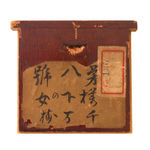
Comes with double wood storage boxes, the outer box lacquered wood, labeled Daihachigō Ōka no onna Chimaki (No. 8, Woman Beneath a Cherry Tree, Chimaki)
A young courtesan, resplendently dressed and coiffed in the fashion of the mid-to-late Edo period (circa 1770-1830), strolls on parade during the spring hanami (cherry-blossom viewing) season. With the finest brushes, the artist Ōbayashi Chimaki renders every detail of her elaborate hairstyle, creating a striking contrast with the more casual splashes of white pigment used for the individual flower petals and the tarashikomi (wet-on-wet) technique that evokes moss clinging to the tree branches at the top of the composition. More than a mere fashion plate, this scroll offers a psychological portrait: soft colors and nuanced brushwork hint at the young woman’s conflicting emotions—pride and frustration—at participating in this seasonal public display, while the gentle folds of her kimono harmonize with the subtlety of her expression.
Ōbayashi Chimaki was celebrated for his richly detailed bijinga (paintings of beautiful women), ambiguously poised like this scroll between historical re-enactment and contemporary portraiture. Yet despite his meticulous research and refined style, his work remains unjustly overshadowed by more famous contemporaries. Born in Okayama City under the name Yorinori, he moved to Tokyo at an early age and studied Japanese painting under two older masters of bijinga: first Tomioka Eisen (1864-1905), and after Eisen’s death, Kaburagi Kiyokata (1878-1972), a leading member of the Tatsumi Gakai artist group that Chimaki would later join. He further broadened his artistic horizons under the guidance of renowned landscape painter Kawai Gyokudō (1873-1957).
Chimaki debuted publicly in 1906 and remained active through the late Meiji, Taishō, and early Shōwa eras, exhibiting primarily at the Saikō Inten (Reorganized Imperial Art Exhibitions, from 1914 onward), as well as at numerous short-lived artist group shows and major events such as the Japan Art Academy Exhibition (1906), the Tokyo Industrial Exhibition (1907), the Tokyo Taishō Exhibition (1914), a Japanese Art Exhibition organized by the Osaka Mainichi Shinbun and Tokyo Nichinichi Shinbun newspapers (1923), and a Kyoto Art Museum exhibition in 1934. A long-time Tokyo resident, he relocated to Nara after the Great Kantō Earthquake and later lived in Nagoya and Kyoto.
Comes with double wood storage boxes, the outer box lacquered wood, labeled Daihachigō Ōka no onna Chimaki (No. 8, Woman Beneath a Cherry Tree, Chimaki)
A young courtesan, resplendently dressed and coiffed in the fashion of the mid-to-late Edo period (circa 1770-1830), strolls on parade during the spring hanami (cherry-blossom viewing) season. With the finest brushes, the artist Ōbayashi Chimaki renders every detail of her elaborate hairstyle, creating a striking contrast with the more casual splashes of white pigment used for the individual flower petals and the tarashikomi (wet-on-wet) technique that evokes moss clinging to the tree branches at the top of the composition. More than a mere fashion plate, this scroll offers a psychological portrait: soft colors and nuanced brushwork hint at the young woman’s conflicting emotions—pride and frustration—at participating in this seasonal public display, while the gentle folds of her kimono harmonize with the subtlety of her expression.
Ōbayashi Chimaki was celebrated for his richly detailed bijinga (paintings of beautiful women), ambiguously poised like this scroll between historical re-enactment and contemporary portraiture. Yet despite his meticulous research and refined style, his work remains unjustly overshadowed by more famous contemporaries. Born in Okayama City under the name Yorinori, he moved to Tokyo at an early age and studied Japanese painting under two older masters of bijinga: first Tomioka Eisen (1864-1905), and after Eisen’s death, Kaburagi Kiyokata (1878-1972), a leading member of the Tatsumi Gakai artist group that Chimaki would later join. He further broadened his artistic horizons under the guidance of renowned landscape painter Kawai Gyokudō (1873-1957).
Chimaki debuted publicly in 1906 and remained active through the late Meiji, Taishō, and early Shōwa eras, exhibiting primarily at the Saikō Inten (Reorganized Imperial Art Exhibitions, from 1914 onward), as well as at numerous short-lived artist group shows and major events such as the Japan Art Academy Exhibition (1906), the Tokyo Industrial Exhibition (1907), the Tokyo Taishō Exhibition (1914), a Japanese Art Exhibition organized by the Osaka Mainichi Shinbun and Tokyo Nichinichi Shinbun newspapers (1923), and a Kyoto Art Museum exhibition in 1934. A long-time Tokyo resident, he relocated to Nara after the Great Kantō Earthquake and later lived in Nagoya and Kyoto.