


Takeuchi Seihō
Sunrise, 1930s
Hanging scroll; ink, mineral pigments and gold on silk
Size overall 54 x 26¼ in. (137 x 66.5 cm)
Size image 16¾ x 20 in. (42.5 x 51 cm)
Size image 16¾ x 20 in. (42.5 x 51 cm)
T-5117
Further images
-
(View a larger image of thumbnail 1
)

-
(View a larger image of thumbnail 2
)

-
(View a larger image of thumbnail 3
)

-
(View a larger image of thumbnail 4
)

-
(View a larger image of thumbnail 5
)
-
(View a larger image of thumbnail 6
)
-
(View a larger image of thumbnail 7
)

-
(View a larger image of thumbnail 8
)

-
(View a larger image of thumbnail 9
)

-
(View a larger image of thumbnail 10
)

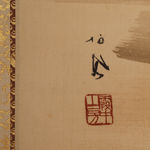
Signed at lower left: Seihō (Inscribed by Seihō); sealed Kachū Kōbō Comes with the original double wood storage box, the outer box lacquered wood, the inner box inscribed outside Chōyō...
Signed at lower left: Seihō (Inscribed by Seihō); sealed Kachū Kōbō
Comes with the original double wood storage box, the outer box lacquered wood, the inner box inscribed outside Chōyō (Sunrise); signed inside Seihō dai (Inscribed by Seihō) and sealed
Takeuchi Seihō found early visual inspiration in the stylish attire of fashionable patrons at his family’s Kyoto restaurant. After a basic education, aged 12 he began formal painting studies in 1877 under Tsuchida Eirin, a textile designer, and from 1881 trained at a private academy led by Kōno Bairei, one of Kyoto’s foremost artists. Seihō soon established himself as an independent artist, creating textile designs and hand-painted garments alongside conventional paintings, and regularly exhibiting his work at local shows.
A turning point came in 1900, when a trip to Europe for the Paris Exposition Universelle gave Seihō an opportunity to study Western art in depth. He even altered the character for sei in his art name to one incorporating the element 西 (“West”). He subsequently rose to prominence as a leading Nihonga painter, blending Kyoto traditions with dynamic perspectives and atmospheric effects inspired by Turner and Corot. His influence extended across the Japanese art world: from 1907 he served as a Bunten exhibition judge; in 1909 he became a professor at Kyoto Municipal College of Painting; and he later founded the Chikujōkai school, mentoring artists such as Uemura Shōen (a major woman artist) and Tokuoka Shinsen. Honored as an Imperial Household Artist in 1913 and inducted into the Imperial Fine Arts Academy in 1919, he received the Order of Culture in 1937, and the French Légion d’honneur in 1924.
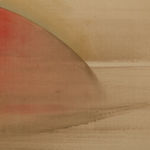
By the time of this painting Seihō, after a prolonged period of ill health, had returned to traditional motifs—refined depictions of nature rendered with delicate brushwork and subtle color harmonies. These qualities shine in this late scroll, atmospheric in both literal and metaphorical senses. The rising sun—possibly at New Year—had been a favored subject since the mid-Edo period (1615-1868). Although the motif acquired nationalistic overtones in the early twentieth century, Seihō treats it here more as a natural wonder, using brilliant red mineral pigment and gold washes to create an impressionistic sunrise that bridges East and West. Until his death in 1942, he remained a towering figure, uniting classical aesthetics with modern sensibilities. His range, virtuoso technique, and lyrical elegance continue to captivate.
Comes with the original double wood storage box, the outer box lacquered wood, the inner box inscribed outside Chōyō (Sunrise); signed inside Seihō dai (Inscribed by Seihō) and sealed
Takeuchi Seihō found early visual inspiration in the stylish attire of fashionable patrons at his family’s Kyoto restaurant. After a basic education, aged 12 he began formal painting studies in 1877 under Tsuchida Eirin, a textile designer, and from 1881 trained at a private academy led by Kōno Bairei, one of Kyoto’s foremost artists. Seihō soon established himself as an independent artist, creating textile designs and hand-painted garments alongside conventional paintings, and regularly exhibiting his work at local shows.
A turning point came in 1900, when a trip to Europe for the Paris Exposition Universelle gave Seihō an opportunity to study Western art in depth. He even altered the character for sei in his art name to one incorporating the element 西 (“West”). He subsequently rose to prominence as a leading Nihonga painter, blending Kyoto traditions with dynamic perspectives and atmospheric effects inspired by Turner and Corot. His influence extended across the Japanese art world: from 1907 he served as a Bunten exhibition judge; in 1909 he became a professor at Kyoto Municipal College of Painting; and he later founded the Chikujōkai school, mentoring artists such as Uemura Shōen (a major woman artist) and Tokuoka Shinsen. Honored as an Imperial Household Artist in 1913 and inducted into the Imperial Fine Arts Academy in 1919, he received the Order of Culture in 1937, and the French Légion d’honneur in 1924.
By the time of this painting Seihō, after a prolonged period of ill health, had returned to traditional motifs—refined depictions of nature rendered with delicate brushwork and subtle color harmonies. These qualities shine in this late scroll, atmospheric in both literal and metaphorical senses. The rising sun—possibly at New Year—had been a favored subject since the mid-Edo period (1615-1868). Although the motif acquired nationalistic overtones in the early twentieth century, Seihō treats it here more as a natural wonder, using brilliant red mineral pigment and gold washes to create an impressionistic sunrise that bridges East and West. Until his death in 1942, he remained a towering figure, uniting classical aesthetics with modern sensibilities. His range, virtuoso technique, and lyrical elegance continue to captivate.